

Shrinktube, Conduit & Fuel hose
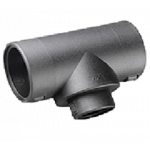

In any professional truck workshop and across the trailer and HGV sector, two recurring technical challenges demand reliable solutions: routing and protecting electrical wiring, and safely conveying fuel through the vehicle's system. Both requirements call for materials capable of withstanding the demanding conditions under which heavy goods vehicles and trailers operate every day. Vibration, temperature fluctuation, water ingress, oil, fuel and mechanical stress are not exceptional circumstances but permanent realities. The category of protection tube and fuel hose brings together the materials that address these challenges in a structured and professional way.
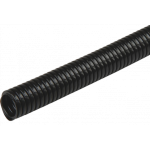
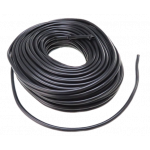
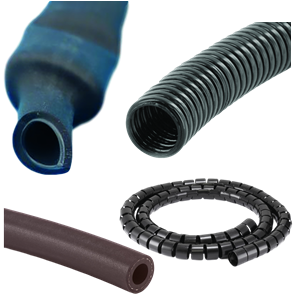
At the foundation of any reliable wiring installation lies adequate protection for cables and cable bundles. Insulation sleeving, also referred to as protective tubing or conduit, forms the first line of defence. These flexible tubes are fitted over cables and wiring runs to provide a continuous protective sheath that guards against mechanical damage, abrasion on sharp structural edges and contact with fluids. In trailer construction and during the installation of electrical systems on semi-trailers, such sleeving is used in substantial lengths, typically supplied on rolls of fifty metres, matching the scale at which professional garages and body builders operate. A range of internal diameters ensures that every cable bundle receives appropriately sized protection.
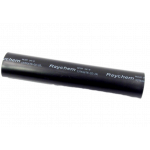
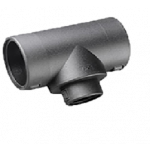
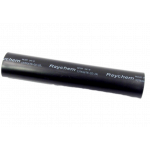
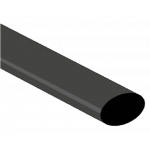
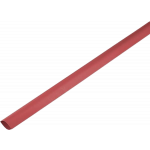
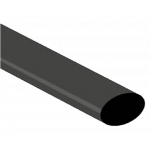
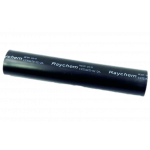
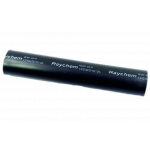
Alongside insulation sleeving, heat shrink tubing plays a central role in protecting electrical connections. Shrink tubing is placed over a connection or cable end and contracts when heated to form a tight, protective layer. Depending on the application, the choice falls either on a version without adhesive lining, offering straightforward insulation and mechanical protection, or on a version with an internal adhesive lining that forms a watertight seal after shrinking. The latter, available in both medium-wall and heavy-wall construction, is indispensable in the truck workshop for connections exposed to moisture, salt, high-pressure cleaning and other aggressive conditions typical of heavy transport. The shrink ratio determines how wide a range of cable diameters a given sleeve can accommodate, with heavy-wall versions offering ratios of up to four to one.
Activating heat shrink tubing requires a heat gun or torch, a tool as essential to the truck workshop as pliers or a screwdriver. Correct technique ensures an even heat distribution around the sleeve, resulting in a uniform shrink without damage to the tubing or the underlying cable. When working with adhesive-lined shrink tubing, proper application of heat is critical to fully activating the adhesive layer and achieving the intended watertight seal.
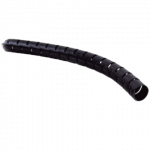
For organising and protecting cable bundles, spiral wrap provides a complementary solution. Where insulation sleeving forms a closed protective tube, spiral wrap surrounds a bundle of cables in an open helical wrap that allows cables to be inserted or removed at any point along the run. This makes spiral wrap particularly practical in installations where the wiring arrangement may still change, or where intermediate branch-offs are needed, such as in the electrical distribution points of a trailer or HGV body.
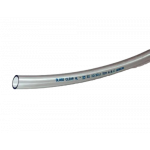
A distinct and specific part of this category is formed by fuel hose. Where insulation sleeving and shrink tubing protect the electrical infrastructure, fuel hose is designed for conveying liquid fuel, including diesel and petrol, within the vehicle's fuel system. PVC fuel hose is chemically resistant to the action of common fuels and is available in a range of internal diameters to suit the connections of pumps, filters and tanks as found in heavy transport applications. The transparent construction allows visual inspection of flow conditions without disassembly, offering a practical advantage during routine maintenance in the truck workshop.
Together these products form a comprehensive package for the electrical and fuel system infrastructure of vehicles in the heavy transport sector. Whether the context is a trailer builder constructing a complete new vehicle, a body builder modifying an existing trailer, or a transport company carrying out routine maintenance in its own workshop, protection tube and fuel hose are materials consumed on a structural and recurring basis. Dekoff supplies this range in professional quantities suited to the scale of B2B operations across the HGV and trailer industry.