

Lamp socket
In the truck workshop and trailer assembly environment, lamp fittings are a component that requires consistent attention. Despite their compact size, fittings play a critical role in the reliable operation of vehicle lighting systems. On trailers and HGVs, fittings are subjected to continuous stress from vibration, moisture, temperature fluctuations, and exposure to road salt or cleaning agents. Selecting the right fitting for the right application is therefore an important decision in any professional lighting installation or repair.
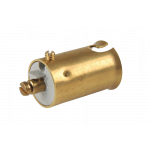
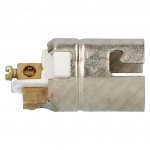
The BA15S fitting is the standard for single-contact lighting functions on trucks, trailers, and semi-trailers. The designation refers to a bayonet base with a 15 millimetre diameter and a single contact point. This fitting type is used in rear lights, brake lights, turn signals, and side marker lights. The bayonet locking mechanism provides a fast and mechanically stable connection between the lamp and the housing, which is practical in a workshop setting where replacement tasks need to be completed efficiently.
Two primary material variants are available for BA15S fittings: metal and PVC. The metal version offers strong electrical conductivity and mechanical rigidity. Its robust construction makes it well suited for applications where vibration is a constant factor, as is the case on a trailer operating on varied road surfaces. Metal fittings also dissipate heat more effectively, which remains relevant for incandescent lamp applications. In enclosed or poorly ventilated lamp housings, this thermal characteristic can be a deciding factor in the choice of fitting material.
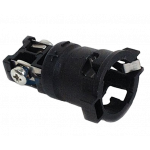
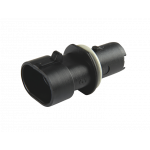
The PVC variant of the BA15S fitting presents a different set of properties. PVC is inherently resistant to corrosion and does not react with moisture, detergents, or chemical cleaning products. This makes PVC fittings well suited for exposed exterior positions on trailers and semi-trailers where the fitting faces direct environmental exposure. The lower weight of PVC compared to metal is a consideration in trailer construction where cumulative weight savings across a full lighting installation have practical significance. The electrical insulation properties of PVC also reduce the risk of unintended current paths via the lamp housing to the vehicle structure.
A specific application that demands particular care is the connection of side marker lights. On vehicles wider than 2.10 metres, side marker lights are a legal requirement and must remain functional at all times. The fitting connecting the lamp base to the wiring harness in a marker light is permanently exposed to the outdoor environment, including direct rainfall, spray water, and road grime. A watertight and corrosion-resistant connection is not optional in this context. A failed or corroded fitting in a marker light can result in a prohibition notice at a roadworthiness inspection or create a hazardous situation in traffic.
For the technician working in a truck workshop, having both metal and PVC BA15S fittings available supports efficient handling of a wide range of repair and installation tasks. When replacing a lamp housing on a trailer, it is standard practice to inspect the fitting and replace it if signs of oxidation or mechanical damage are present. Corroded contact points in a metal fitting cause increased contact resistance, which can manifest as flickering lights or reduced light output. In trailer construction, where lighting systems are installed from new, the choice of fitting material contributes to the service life of the entire lighting assembly.
In practical HGV and trailer workshop operations, both metal and PVC BA15S fittings serve defined roles depending on the location within the housing, the degree of environmental exposure, and the nature of the lighting function. Metal fittings are generally selected for built-in or sheltered positions, while PVC fittings are preferred for unprotected exterior locations. Keeping both variants in stock ensures that every repair or installation task on a trailer or HGV can be completed to the required technical standard.