

Battery terminal
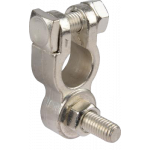
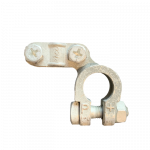
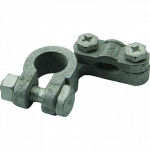
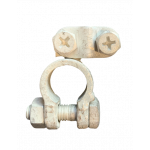
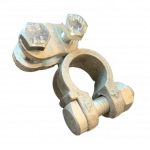

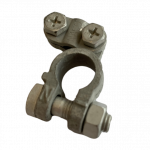
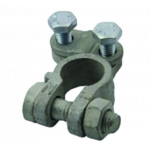


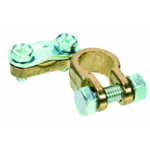
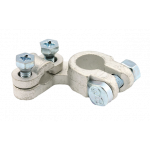
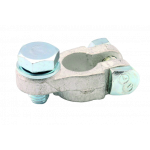
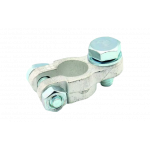
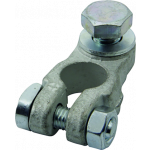
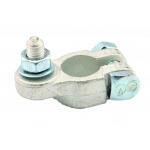
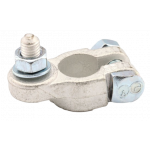
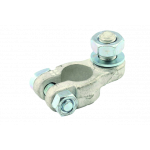
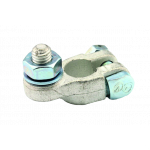
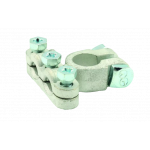
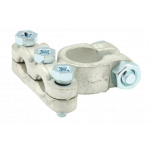
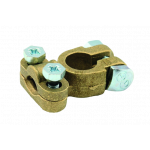
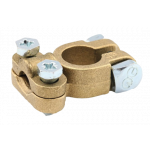
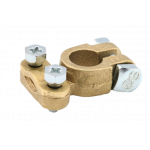
A reliable battery connection is the foundation of every electrical system in a truck or trailer. In 24V environments, which are standard in heavy transport, the connection at the battery pole places specific demands on the components used. The battery terminal clamp truck is a critical element at this point: it is where the entire electrical installation draws its supply, and where a poor connection directly causes power loss, voltage drop, or in the worst case, fire risk due to resistance heat.
When selecting a pole clamp HGV 24V, technical criteria go well beyond the basic dimensions of the battery post. The cable cross-section with which the clamp must be compatible largely determines which version is appropriate. Lighter applications typically use cable cross-sections of 25 to 35 mm², while heavier vehicles with multiple consumers or higher starting currents require cables of 35 to 50 mm² or even 50 to 70 mm². Each cable dimension requires a corresponding clamp geometry to guarantee correct clamping force and low contact resistance.
The classification of battery terminal clamps by left or right orientation, and positive or negative, is not arbitrary. The orientation of the clamp determines the cable routing through the engine compartment or battery enclosure. An incorrectly chosen version leads to tensioned cables, unwanted bending points, or housings that are difficult to close. Trailer builders and body builders who work with these installations daily know that choosing the correct orientation simplifies assembly considerably and extends the service life of the cable connection.
In addition to orientation, bolt length plays a role. A short connecting bolt allows a compact arrangement and is suitable for situations where space in the engine compartment is limited. A long connecting bolt provides extra cable clearance and makes it possible to stack multiple cable lugs on a single connection point. This is of great practical importance in trailer construction and body building, where multiple circuits often converge on a single battery pole.
A particular point of attention in the truck and trailer sector is the chemical environment around the battery. Electrolyte vapours, condensation and splashes of battery acid cause unprotected metal connections to corrode rapidly. Acid-resistant battery terminal clamps provide the necessary resistance in these conditions. The DIN 72331 standard applies specifically to battery terminal clamps for motor vehicles and describes the mechanical and electrical requirements these connections must meet. Reinforced versions complying with DIN 72331 offer additional mechanical rigidity and a stable clamping mechanism, even under the vibrations and thermal fluctuations continuously present in moving vehicles.
For specific vehicle applications, such as those common in DAF and MAN trucks, terminal clamps with larger bolt sizes such as M10 or M12 are used. These provide greater clamping force than standard versions and withstand the forces generated when starting heavy diesel engines with high starting currents. The bolt selection must always correspond to the cable lugs used in the installation.
A separate category comprises terminal clamps designed for use in combination with a CF8 main fuse. In modern vehicle installations, the main fuse is placed directly at or near the battery pole in order to protect the installation as early as possible in the current path. The geometry of these specialised terminal clamps is matched to the housing of the fuse holder, enabling an integrated and space-saving assembly.
The material of the battery connector truck also deserves attention. Lead alloys have traditionally been used due to their corrosion resistance and good electrical conductivity, combined with a softness that prevents damage to the post during installation. In more heavily loaded applications, reinforced constructions are used that are mechanically more robust and maintain stable contact pressure even at higher current levels.
In the day-to-day practice of a truck workshop or trailer manufacturing facility, the battery terminal clamp is a component that is replaced regularly, for example during overhaul of the battery installation, replacement of battery cables, or after corrosion damage. A well-assorted range of terminal clamps in the correct versions, bolt sizes, and cable ranges ensures that the technician can always make the technically correct connection, without compromise on safety or conductivity. Dekoff supplies battery terminal clamps that meet the requirements of professional workshops in the truck and trailer sector, with versions for both 24V systems and specific vehicle configurations.