

Pull switch
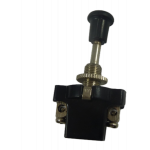
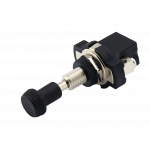
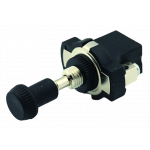
In the daily operations of a truck workshop or trailer manufacturing environment, pull switches are among the most widely used switching solutions for controlling electrical circuits in vehicles and trailers. The operating principle is straightforward: pulling the switch closes or opens a circuit, and it remains in that position until operated again. This makes the type particularly well suited for functions where the current switching state must be visibly and physically maintained, without any automatic return to the initial position.
When building or overhauling a trailer or semi-trailer, pull switches appear in a wide range of applications. These include switching work lighting, activating pump systems, operating hydraulic circuits, or enabling auxiliary aggregates. In situations where a technician or driver needs to activate a function quickly and without looking, the pull switch offers a practical advantage. The pulling motion is intuitive and requires no visual confirmation of the switch position itself.
Pull switches used in truck and trailer electrical systems are generally designed for 24V systems, the standard voltage in the European heavy goods vehicle market. Depending on the intended use, the maximum current rating varies, with values around 12 to 12.5 amperes being common for this type of switch. This makes them suitable for a broad range of electrical functions that do not require the highest current loads but do demand reliable and durable switching performance.
For trailer builders and bodywork manufacturers running multiple vehicles in production simultaneously, the availability of pull switches in larger quantities is a practical consideration. Series production requires consistent components that function in the same way every time and can be installed under the same conditions. At the same time, in the truck workshop there is a regular need for individual switches for replacement work or smaller repairs where only a single component is required. Both situations call for a flexible range where both smaller and larger order quantities are possible.
The compact housing of the pull switch allows installation in locations where space is limited, such as in switch cabinets, instrument panels, or the side walls of semi-trailers. In HGV trailer construction, fixed installation positions are often determined at the design stage, where the dimensions of the switch directly influence the choice. A short pull switch fits in situations where the installation depth is restricted, which is frequently the case in trailers and semi-trailers due to the compact design of the electrical enclosure or dashboard.
For technicians in the truck workshop carrying out maintenance or modifications on existing vehicles, the pull switch is also a frequently requested replacement component. Wear, mechanical damage, or a faulty pull mechanism are common reasons why pull switches are periodically replaced. A switch with direct and reliable operation ensures that the function connected to it can be activated without delay or uncertainty. That matters in a workshop setting, but equally in the real-world conditions a driver faces on the road.
Within the broader context of vehicle electrics for truck and trailer applications, pull switches form a standard part of the component range used in new builds as well as in overhaul and repair work. Whether the application involves a refrigerated semi-trailer, a tipper trailer, or a specialist low-loader, the fundamental need for reliable switching solutions for 24V systems is present across all these uses. The pull switch fulfils a functional and proven role that has been standard practice in the European truck and trailer sector for decades.