

Electrical charging coils

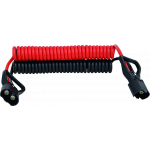
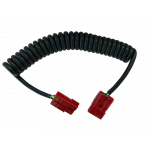
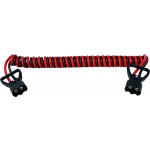
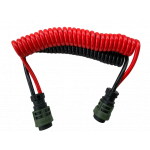
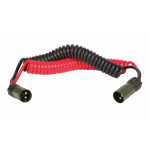
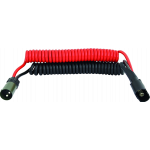
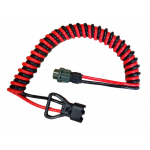
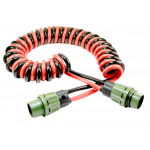
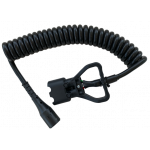
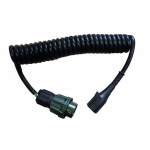
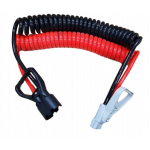
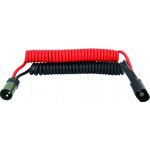
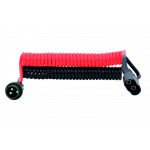
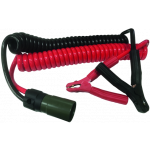
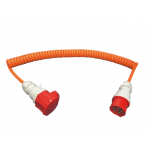
A charging spiral cable is an essential component in the truck and trailer sector whenever high currents need to be transferred flexibly and reliably between a vehicle and a trailer, or between a charging device and a battery system. The coiled structure of the cable allows it to extend with the distance between two connection points, retract automatically after use, and remain off the ground during operation. In a workshop environment or on a site with heavy traffic, this is not a minor detail but a functional requirement that directly contributes to the service life of the cable.
The conductor cross-section determines the current-carrying capacity of the cable. For charging battery systems in heavy vehicles, jump-starting trucks with an external power source, or connecting inverters and chargers, conductors of 2x35mm² are the standard choice. This cross-section is dimensioned for the high currents involved in these applications and minimises heat build-up in the cable during use. For lighter applications such as connections to distribution systems or smaller charging equipment, 3x6mm² or 5x2.5mm² conductors are sufficient, depending on the number of phases and the required current rating.
The connector type largely determines the applicability of a power spiral cable trailer. A Rema spiral cable is fitted with a connector according to the Rema DIN 43589 standard, an industrial standard widely used in electrically driven vehicles and charging systems. The Rema connector is recognised by its standardised polarity and robust construction, designed for intensive use in professional environments. An Anderson Power coiled cable uses the Anderson Power connector, another industrially accepted standard for heavy-current connections. The 175A Anderson Power connector is used with battery systems, inverters, and direct charging connections on trailers and semi-trailers.
In addition to Rema DIN 43589 and Anderson Power versions, charging spiral cables are also available with NATO connectors conforming to VG 96917. This military connection standard is not limited to defence vehicles but is also used in specialised heavy civil transport and specific vehicle combinations. The NATO connector is available with and without a locking ring. The locking ring version adds a mechanical lock that secures the connection against vibration, shock, and accidental disconnection. For applications on rough terrain or on vehicles regularly subjected to heavy mechanical stress, the locking version offers a clear advantage over the standard type.
A charging spiral cable with a CEE connector connects to the standardised CEE norm and is suitable for locations with industrial power supplies, such as workshops and depots. With a nominal current of 32A and a multi-phase configuration, this version is suitable for powering electrical equipment on or around the trailer. The working length of 3.55 metres provides sufficient freedom of movement for applications where the cable is connected and disconnected on a regular basis.
Some charging spiral cables combine two different connector standards on a single cable. A Rema spiral cable with a NATO connector on the other end makes it possible to connect a vehicle with a Rema socket to a system based on VG 96917. The same principle applies to combinations of Anderson Power and NATO, or Rema and Clang. These hybrid versions are particularly useful in practice when a workshop or transport company works with vehicles from different manufacturers or generations that do not share the same connection standard.
In the day-to-day practice of trailer builders, body builders, and truck workshops, charging spiral cables are used to connect auxiliary batteries to tractor units, charge electrical systems on refrigerated and curtainsider trailers, jump-start disabled vehicles with an external source, and power electrical installations during maintenance. The coiled design prevents loose cables from becoming a hazard on the work floor and contributes to an organised working environment. Transport companies with their own workshop select cables with connectors that match their existing charging infrastructure, while trailer builders and body builders more often choose versions that meet the specifications of the end customer or the required vehicle standard.