

Twin cable
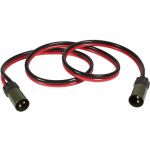
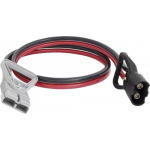
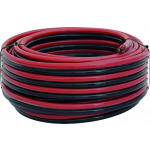
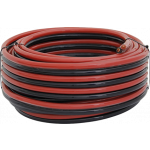
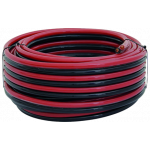
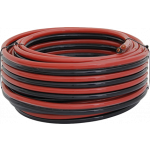
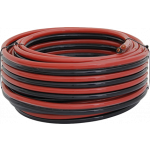
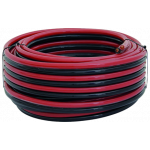
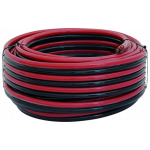
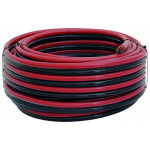
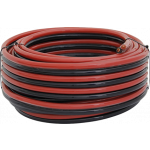
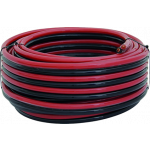
Twin cable is a fundamental wiring solution in the truck workshop and trailer industry, used wherever positive and negative conductors need to be routed together as a single unit through a vehicle, trailer, or HGV body. The parallel double-conductor construction, with a red and a black wire enclosed in a shared sheath, provides immediate polarity identification and reduces the risk of incorrect connections during installation. In a professional working environment where multiple DC circuits are installed in quick succession or must remain serviceable over time, this clarity is a genuine practical advantage.
Selecting the right conductor cross-section is a critical decision in any truck workshop or trailer build. For lighter DC applications at 12V or 24V, such as auxiliary battery connections, inverters, or electrical accessories on a trailer or HGV, a twin cable with a conductor cross-section of 4 or 6mm² per wire is typically sufficient. As current demands increase, for example in charging systems, heavy battery connections, or solar panel to inverter wiring, larger cross-sections of 10, 16, 25, 35, or 50mm² per conductor become necessary. Each increase in cross-section reduces resistance, limits voltage drop over longer cable runs, and improves the overall reliability of the installation.
In trailer construction, twin cable is used extensively for main power feeds to refrigeration or hub aggregates, connections for hydraulic systems drawing power from the vehicle's electrical supply, and multi-battery configurations in semi-trailer setups. A refrigerated trailer or a unit with an electrically operated tail lift will often require several twin cables of different cross-sections running through the chassis cable ducts. The twin cable format ensures that both conductors are routed together in a controlled manner, making it straightforward to guide the cable through conduits, brackets, and cable entries without separating the positive and negative leads.
In the truck workshop, twin cable is a standard choice when adding supplementary wiring for bodywork installations, cranes, tipping bodies, or cooling equipment. When a HGV is converted or extended with additional electrical systems, the paired conductor format means both wires can be pulled through an existing conduit simultaneously, saving installation time and producing a tidy result that is easier to inspect and maintain during future service intervals.
The flexible stranded construction of twin cable conductors, built from multiple fine wires rather than a solid core, makes them well suited to environments where the cable is subject to vibration, movement, or mechanical stress. This is particularly relevant in a moving vehicle or a trailer exposed to the continuous demands of road transport. The outer sheath protects both conductors against moisture, abrasion, and the demanding conditions that are unavoidable in truck and trailer applications.
For professional use in the truck workshop or trailer industry, twin cable is available in fixed lengths of 25 or 50 metres. The larger reels are especially practical when multiple vehicles are being fitted with the same wiring configuration, as in series trailer production or fleet maintenance programmes. Having sufficient cable on hand avoids delays and ensures that longer cable runs within a HGV body or semi-trailer chassis can be completed without joins.
In summary, twin cable occupies a central role in DC electrical installations across the truck and trailer sector. Whether the application involves a light auxiliary feed on a drawbar trailer, a heavy battery connection on a semi-trailer, or supplementary wiring on a HGV, the correct twin cable provides a dependable connection that meets the demands of daily transport operations.