

Battery cables
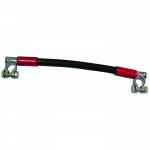
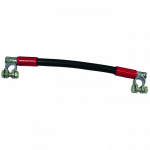
In a professional truck workshop, a secure and properly dimensioned battery connection is fundamental to the reliable operation of heavy vehicles. Battery connection cables are used to link multiple batteries within a single vehicle system, enabling series or parallel configurations that meet the high current demands of starter motors, refrigeration units, hydraulic systems and onboard electronics. A cable cross-section of 50mm² is well suited to these applications, providing sufficient current-carrying capacity while minimising resistive losses and heat generation within the connection.
In trailer construction and among specialists working on semi-trailers, battery systems are frequently distributed across the chassis or body structure. The physical distance between battery terminals varies depending on vehicle type and the chosen battery box arrangement. For this reason, battery connection cables are available in different lengths. A 250mm cable covers installations where batteries are mounted close together, as is common in standard dual-battery configurations in tractor units. A 400mm cable is used when the distance between terminal points is greater, for example when a battery is fitted in a non-standard position or when the box construction requires additional clearance.
Battery terminal clamps at both ends of the cable provide a direct connection to the battery poles without the need for intermediate connectors or additional hardware. In a busy truck workshop where multiple HGV units are serviced simultaneously, fewer components translate to fewer potential failure points and reduced assembly time per vehicle.
For trailers with their own power supply, such as refrigerated trailers or trailers equipped with electronic braking systems, the integrity of the battery connection is critical. A loose or corroded connection can cause voltage issues in the EBS or refrigeration motor, potentially resulting in vehicle downtime or cargo damage. The battery connection cables used in this segment are designed to withstand the mechanical stress and vibrations that are characteristic of heavy road transport.
In body building and conversion work, where additional electrical systems such as tail lifts, cranes or cooling units are integrated into the vehicle, connection cables are used to link these additions to the existing battery system. The 50mm² cross-section makes this feasible without the need for a separate heavy-duty wiring network for the connection function alone.
Wholesalers supplying truck workshops and trailer manufacturers typically stock battery connection cables in multiple lengths because demand is closely tied to vehicle type and battery configuration. Practical knowledge of the application matters: a cable that is too short will be held taut and may work loose due to vibration or thermal expansion. A cable that is too long may sag and risk damage through contact with moving or hot components.
In the day-to-day practice of the truck and trailer sector, battery connection cables are used both in new builds and during the revision or replacement of ageing battery installations. The combination of the correct cable length, a reliable cross-section and robust terminal clamps largely determines how long a battery installation performs without issues. For workshops and builders working on heavy vehicles, semi-trailers and trailer electrical systems, having the right connection cables available is a practical requirement within routine maintenance and electrical system assembly.